

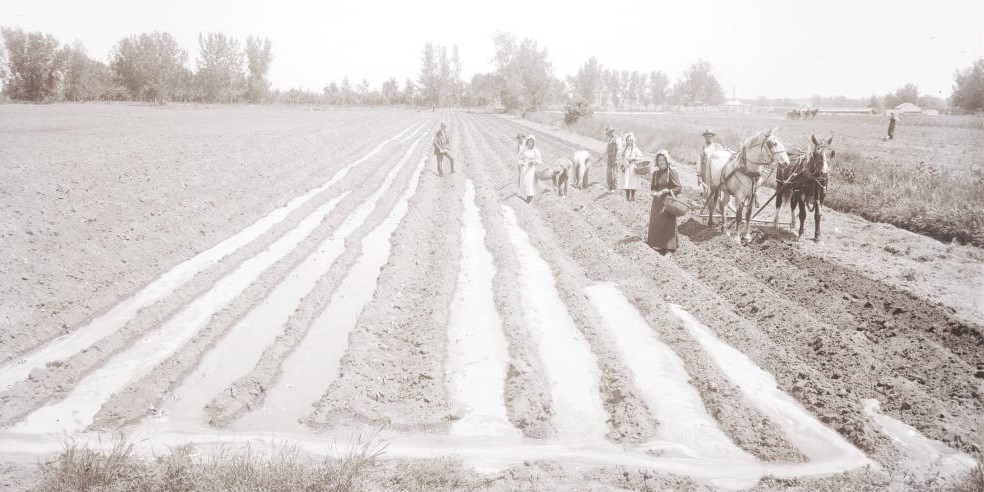
Colorado’s water resources have played a significant role in the state’s history. The Water Resources Archive at Colorado State University documents that role, but cannot do so without assistance from individuals and organizations who have also shaped Colorado’s history.
Letters, diaries, photos and other materials created over the years give vital and unique information regarding Colorado’s water history. While these materials obviously matter to you, they may be important to a wider audience as well. When you donate your historical materials to the Water Resources Archive, your history becomes a part of Colorado’s collective memory.
The Water Resources Archive began in 2001 in cooperation with the Colorado Water Resources Research Institute and the Colorado Agricultural Archives with the purpose of documenting the study and development of water resources in Colorado. The Archive preserves collections of written, visual and audio material created by individuals and organizations in order to document specific events and broader societal trends, as well as the general history of water in Colorado. The Archive ensures that these materials will be available for generations to come, enabling researchers to study Colorado’s water history as comprehensively as possible.
The Water Resources Archive will provide your donated materials with secure, environmentally sound storage. The Archive also will organize the materials and create a finding aid—a standard archival tool describing a collection of materials, which includes information on the collection creator as well as a folder-level inventory of each box. The finding aid will be available to researchers over the Internet, along with digitized items as deemed appropriate.
The Water Resources Archive accepts materials in any format that are related to the study and development of water resources in Colorado. Materials need not be organized or “old” or related to a prominent entity or event in order to be historically significant. Because the research value of records may be diminished if items are removed or rearranged, donors are encouraged to contact the Archive before discarding or reorganizing materials.
Although the Water Resources Archive cannot accept everything that may be offered, it welcomes the chance to review material. If it is not appropriate for CSU, there may be another repository to which it could be referred. Some material, though, may be of more sentimental than historical value and should be kept by the individual or family.
An organization’s history lies in the letters, minutes, reports, photographs, publications and other documents created over the years by officers, members, directors, employees and volunteers. These documents provide unique testimony to the organization’s achievements and are also valuable for administrative, legal, fiscal and public relations purposes.
The Water Resources Archive is interested in the records that best illustrate the purpose, activities and policies of your water-related organization. The Archive prefers acquiring related groups of materials rather than individual items. Records should be inactive—that is, no longer regularly used for routine business. If your organization is an ongoing enterprise, it is best to donate records periodically. An archivist will discuss with you appropriate intervals for making those donations. To assure regular contact, your organization might add the periodic transfer of inactive records to the duties of one of its officers.
The Water Resources Archive accepts only permanent donations of materials. Donors are asked to sign a donation agreement, called a Deed of Gift, which formally signifies that the materials become the property of the Archive.
Once materials are donated, researchers and other users will be able to access them by visiting the Archive. Materials are used on location and under supervision, in order to ensure security and long-term preservation. Prospective donors should become familiar with Archive policies on access and use and discuss any special needs or concerns with the archivist before completing the donation agreement.
Sensitive items that may exist in the collection should not be removed by the donor. Instead, you should discuss with the archivist the possibility of restricting part of the collection to address privacy concerns, trade secrets or similar matters. While the Water Resources Archive desires to make all papers accessible to users, it can agree to reasonable restrictions for limited periods of time.
Assignment of copyright is often complex, and donors should work with Archive staff to clarify issues of copyright ownership prior to completing a donation agreement. Generally, copyright belongs to the creator of writings and other original materials (such as photos and music) but can be legally transferred to heirs or others. Moreover, ownership of copyright is separable from ownership of the physical item (the letter or photo). The Water Resources Archive asks donors to donate not only the physical materials but also any copyright in them that the donor might own. This facilitates researcher use of quotations from the materials and digitization of the materials.
In certain circumstances, it may be possible for a donor to take a tax deduction for the donation of a collection. Donors are encouraged to speak with their tax accountants or attorneys about this. Archivists cannot give tax advice, nor are they permitted to appraise the monetary value of a collection. The Archive can provide donors with a list of local appraisers who can (for a fee) make monetary appraisals. It is a donor’s responsibility to arrange for and bear the cost of appraisal.
Preparing materials for use by researchers is the most expensive operation in any archive. Although monetary grants are not a prerequisite for the acceptance of a collection, donors who are able to assist the Water Resources Archive by making grants toward the arrangement, cataloging and preservation of their donations are encouraged to do so.
Please contact the Water Resources Archive if you would like to discuss making a donation.
Phone: (970) 491-1844
E-mail: Special Collections
Mail: Water Resources Archive
Archives & Special Collections
Morgan Library
Colorado State University
Fort Collins, CO 80523-1019
Above photo: Big Thompson flood damage, 1976. From the Papers of Daryl B. Simons.
This brochure was modeled on guides published by the Society of American Archivists.